<table id="tablepress-250" class="tablepress tablepress-id-250">
<tbody class="row-striping">
<tr class="row-1">
	<td class="column-1">Real Name:</td><td class="column-2">Camera Ashe</td>
</tr>
<tr class="row-2">
	<td class="column-1">Birthday:</td><td class="column-2">1986</td>
</tr>
<tr class="row-3">
	<td class="column-1">Net Worth</td><td class="column-2">N./A</td>
</tr>
<tr class="row-4">
	<td class="column-1">Height:</td><td class="column-2">N/A</td>
</tr>
<tr class="row-5">
	<td class="column-1">Occupation:</td><td class="column-2">Adopted Daughter of Arthur Ashe and Jeanne Moutoussamy-Ashe</td>
</tr>
</tbody>
</table>
<!-- #tablepress-250 from cache -->
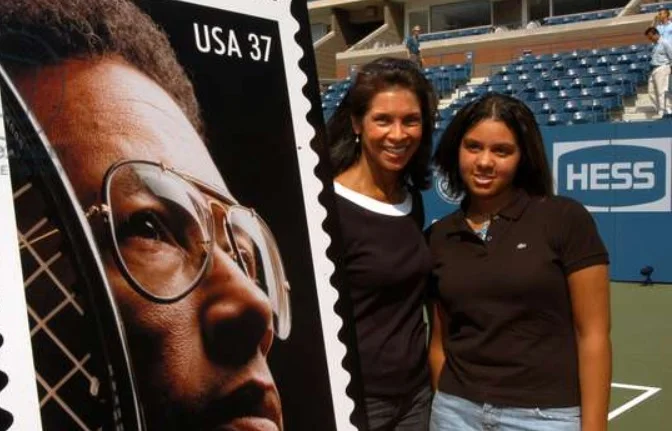
<p>Camera Ashe is the adopted daughter of the legendary<strong> American tennis player Arthur Robert Ashe Jr.</strong> and his wife <strong>Jeanne Moutiussamy Ashe.</strong></p>
<p>She is the only daughter of the legendary professional tennis player. Arthur and his wife, <strong>photographer</strong> Jeanne Moutoussamy Ashe adopted Camera in <strong>December 1986</strong> after they were unable to conceive a child.</p>
<p>Jeanne named her after her profession as a photographer. Hence, the name Camera.</p>
<h2>Who Was Her Celebrity Father?</h2>
<p>Almost anyone who watches professional sports, not even tennis, has probably heard of Arthur Ashe. Born Arthur Robert Ashe Jr. in July 1943, he <strong>passed away in February 1993</strong>. He was an American professional tennis player who<strong> won three</strong><em> Grand Slam</em> <strong>singles titles.</strong></p>
<p>Arthur began playing tennis at the <strong>early age of seven</strong>. Born in Richmond, Virginia, to Mattie Cordell and <strong>Arthur Ashe Sr.</strong>, he had a brother<strong> Johnnie Ashe</strong>. They were born in a family that claimed direct descent from <strong>Amar,</strong> a West African woman who was enslaved and brought to America in 1735.</p>
<p>Arthur was the first black player selected to the <em>United States Davis Cup</em> team, and the only black man ever to win the singles title at <em>Wimbledon,</em> the <em>US Open,</em> and the <em>Australian Open</em>. In 1980, Arthur <strong>retired from professional tennis.</strong></p>
<p>Ashe did not have an easy childhood. His mother Mattie passed away in <strong>March 1950</strong> from complications related to a<strong> toxemic pregnancy,</strong> nowadays known as pre-eclampsia. Ashe and his brother were raised by their caring father.</p>
<p>It was Ashe Sr. who encouraged Arthur to excel both in school and sports. Yet, he forbid him to play American football, which was a popular game for many boys at the time. It was all due to Ashe’s slight build. Because of his build, he was nicknamed “Skinny” and “Bones” in his childhood.</p>
<p>He began practicing and playing tennis at seven years of age, practicing on the courts of their caretaker’s cottage. The family lived in a cottage on the grounds of <strong>18-acre Brookfield Park,</strong> the largest black-only public playground in Richmond. There, his talent was spotted by <em>Virginia Union University</em> student and <strong>tennis instructor Ron Charity.</strong></p>
<p>He began teaching Ashe things like basic strokes and encouraged him to enter local tournaments. Arthur attended <em>Maggie L. Walker</em> high school, where he continued to practice tennis. He was coached by<strong> Althea Gibson.</strong></p>
<p>In 1960, he was precluded from competing against white youths in segregated Richmond during the school year. He was unable to use the indoor courts in the city, which were closed to black players.</p>
<p>So, he accepted an offer from <strong>Richard Hudlin</strong>, a 62-year-old teacher and tennis coach at the time, to move to St. Louis and spend his senior year there. Arthur could compete more freely there, living with Hudlin and his family.</p>
<p>In 1963, he was awarded a tennis scholarship from the <em>University of California,</em> Los Angeles. During his time there, he was coached by <strong>J.D. Morgan</strong>. The same year, he became the first black player ever selected for the <em>United States Davis Cup</em> team. In 1965, he ranked as the<strong> Number 3 player in the United States.</strong></p>
<p>During his professional career, he made it to the <strong>Finals 7 times</strong> and <strong>won three</strong> <em>Grand Slam</em> singles titles. His first appearance in the <strong>Finals</strong> was at the <em>1966 Australian Open</em>, where he lost to <strong>Roy Emerson.</strong> He lost to Roy again in the <strong>1967 Finals</strong> as well.</p>
<p>Ashe’s first title came at the US Open in 1968, beating<strong> Tom Okker.</strong> Two years later, he finally won the<em> Australian Open</em>, beating<strong> Dick Crealy</strong> in the process. His final title came in 1975 at <em>Wimbledon,</em> beating <strong>Jimmy Connors.</strong></p>
<p>In Ashe’s honors, the central stadium at the <em>US Open</em> is called <em>Arthur Ashe Stadium</em>. The tennis arena at <em>Flushing Meadows-Corona Park</em> in Queens, New York, serves as the venue for the <em>US Open Grand Slam Final.</em></p>
<p>Upon his retirement, Ashe worked as a writer for Time Magazine and <em>The Washington Post</em>, and commentator for <strong>ABC Sports</strong> and <strong>HBO.</strong> In 1985, he was elected to the <em>International Tennis Hall of Fame.</em></p>
<p>Throughout his life, he was an active civil rights supporter. In September 1988, he was <strong>diagnosed with HIV</strong>. His doctors believed he contracted the virus from <strong>blood transfusions</strong> he received during his<strong> second heart surgery.</strong> He and his wife kept the illness private for the sake of their daughter.</p>
<p><amp-youtube layout="responsive" width="662" height="372" data-videoid="ky-KPrTMx6E" title="Who was Arthur Ashe?"><a placeholder href="https://www.youtube.com/watch?v=ky-KPrTMx6E"><img src="https://i.ytimg.com/vi/ky-KPrTMx6E/hqdefault.jpg" layout="fill" object-fit="cover" alt="Who was Arthur Ashe?"></a></amp-youtube></p>
<h2>Quick Bio</h2>
<p>Now let’s talk about Arthur’s adopted daughter, Camera Ashe. She got adopted by Arthur and his wife Jeanne Moutoussamy Ashe in December 1986. At the time, Arthur was an American professional tennis player.</p>
<p>Her mother, Jeanne, is a well-known activist, educator, and photographer. Known for her work in several newspapers, Jeanne has been published in <em>Life, People Weekly,</em> and <em>Sports Illustrated.</em></p>
<p>There is<strong> no info</strong> about the educational background or professional career of Camera. Her age as of July 2023 should be 37 years of age. There is no info about her exact birth date.</p>
<p>She grew up with her family in the United States and was named after her mother’s profession. Just 19 months after she was adopted, her father got diagnosed as <strong>HIV positive</strong>. He contracted the virus due to a blood transfusion he had to get during a heart bypass surgery.</p>
<h2>Daddy And Me</h2>
<p>Arguably one of the best features about Arthur Ashe is the one made by Jeanne Moutoussamy Ashe. Titled <em>Daddy and Me</em>, it is a<strong> gentle, domestic father-daughter love photo story.</strong> It tells the story of the tennis champion who passed away from AIDS in February 1993 and his daughter.</p>
<p>The photo project consists of <strong>black-and-white photographs</strong>, and it tells a story about <strong>connectedness to a parent,</strong> who, because of illness, will not be there in his child’s future. At the same time, he is living and sharing the present they have.</p>
<p>The photographs capture intimate moments of Camera&#8217;s father’s bad days. Her mother wanted to make them <strong>help Camera remember her father</strong> as a public figure.</p>
<p>The public also gets to see the good days, when Camera and her father spend time hanging out, going through everyday emotions, and reading books.</p>
<p>We know many adults try to explain illness to their children. And it is not an easy one. Jeanne added text in a clear and simple voice to describe Camera’s perception of her father’s experience, like <em>“Sometimes Daddy runs a fever and feels very tired. Like when you have a stomach ache. You just don’t feel very good”.</em></p>
<p>Jeanne Moutoussamy-Ashe is an American photographer and <strong>AIDS activist</strong>. She was married to Arthur from 1977 until his eventual death in 1993.</p>
<h2>Where Is She Now?</h2>
<p>Camera Ashe has managed to live a private life most of the time. Yet, occasionally, she appears in public. For example, she supported <strong>Caitlyn Jenner</strong> when the latter received the<em> Arthur Ashe Courage Award.</em></p>
<p>Camera called Caitlyn a <strong>true warrior</strong> and praised her bravery as inspirational.</p>
<p>Camera also appeared on the promotion of the documentary <em>Citizen Ashe</em>. It tells the story of the legendary tennis player, his achievements, and his tragic death. Arthur was the <strong>first African American to win</strong> <em>Wimbledon.</em></p>
<p>The documentary also explored how Ashe contributed to the world of tennis and human rights activism.</p>
<h2>Is She On Social Media?</h2>
<p>Camera Ashe is<strong> not active</strong> on social media. She decided to live a low-profile life. She rarely comes out in the media.</p>
<h2>Net Worth</h2>
<p>There is no clear information about the net worth and earnings of Camera Ashe. Truth be told, we have no information about her educational background or professional career.</p>
<p>What we do know is the net worth of her mother. Jeanne has a net worth of <strong>$5 million</strong>. And her father had a net worth of<strong> $4 million</strong> at the time of his passing.</p>

Camera Ashe – The Legacy Of Arthur Ashe Lives On