<table id="tablepress-15" class="tablepress tablepress-id-15">
<tbody class="row-striping">
<tr class="row-1">
	<td class="column-1">Real Name:</td><td class="column-2">Carlos Santana</td>
</tr>
<tr class="row-2">
	<td class="column-1">Birthday:</td><td class="column-2">July 20, 1947</td>
</tr>
<tr class="row-3">
	<td class="column-1">Net Worth:</td><td class="column-2">$80 million</td>
</tr>
<tr class="row-4">
	<td class="column-1">Height:</td><td class="column-2">176 cm</td>
</tr>
<tr class="row-5">
	<td class="column-1">Occupation:</td><td class="column-2">Mexican-American Guitarist, Music Artist, Songwriter,<br />
Bandleader, Film Score Composer</td>
</tr>
</tbody>
</table>
<!-- #tablepress-15 from cache -->
<p><strong>Carlos Santana is a Mexican and American musician.</strong> He is popular and famous all over the world. The guitarist <strong>rose to fame in the late 1960s and early 1970s</strong> with his <strong>band</strong> <em>Santana</em>. The band pioneered a<strong> fusion of rock and roll and Latin American Jazz</strong>. After many years in the business, <strong>Carlos Santana&#8217;s wealth is over $80 million</strong>. How he earned it? Let’s take a quick look at his career.</p>
<p>In the beginning, Santana and his band invented a sound featuring his<strong> melodic, blues-based lines set against Latin and African rhythms.</strong> They placed on percussion instruments which were unknown to the rock genre. Some of their instruments included <strong>congas and timbales</strong>. In the late <strong>1990s</strong>, Carlos Santana experienced a <strong>resurgence of popularity.</strong></p>
<p><strong>In 2015,</strong> the <em>Rolling Stone magazine</em> listed him at <strong>No.20 on the list of 100 greatest guitarists ever.</strong> So far, he won <em><strong>10</strong> Grammy Awards</em>, <strong>three</strong> <em>Latin Grammy awards</em>, and many other achievements. Santana got inducted into the <em>Rock and Roll Hall of Fame</em> in <strong>1998</strong>.</p>
<h2>Career Summary</h2>
<p>Santana started his<strong> career in the 1960s and 1970s</strong>. Before he started his career, he listened to artists such as <strong>B.B. King</strong> and <strong>T-Bone Walker</strong> in the <strong>1950s</strong>. Soon after he started playing guitar. As a result, he joined local bands along the <strong>Tijuana Strip</strong>. There, Carlos developed his own sound.</p>
<p>In his early days, Carlos got introduced to different <strong>musical influences</strong>. Some of them include<strong> jazz, folk music, and the hippie movement</strong>. He worked as a dishwasher in a diner and busking for spare change. In the early <strong>1960s</strong>, he left work to become a <strong>full-time musician</strong>. In 1966, he got selected as part of the <strong>ad hoc band</strong> to substitute an intoxicated <strong>Paul Butterfield</strong> at <strong>Bill Graham’s Fillmore Auditorium.</strong></p>
<p>During the same year, Carlos and his fellow street musicians formed the<strong> Santana Blues Band.</strong> Original members include <strong>David Brown bass guitar, Marcus Malone percussion,</strong> and <strong>Gregg Rolie lead vocals.</strong></p>
<p>The band got their <strong>first contract</strong> with <em>Columbia Records</em>. The label shortened their name to <strong>Santana</strong>. In <strong>January 1969</strong>, they went into the studio to record the first album. The band shifted members, <strong>welcoming Jose CHepito Areas</strong> and<strong> Mike Shrieve.</strong></p>
<p>Santana benefited from their friendship with <strong>major rock music promoter Bill Graham</strong>. He was a fan from their start and arranged for the band to appear at the <strong>Woodstock Music and Art Festival.</strong> This was before their debut album saw the light of the day. <strong>Santana</strong> was the surprise of the festival.</p>
<p>Their performance at <strong>Woodstock</strong> introduced the band to an international audience. The sudden success had good and bad sides. While success was great, it also put pressure on the group.</p>
<p><strong>In September 1970</strong>, the band released their <strong>second album, Abraxas.</strong> With a mix of blues, jazz, rock, salsa, and other genres, the album <strong>topped the Billboard chart for six weeks</strong>. This album includes two of their most famous hits,<em> Oye Como Va</em> and <em>Black Magic Woman</em>. The album spent <strong>88 more weeks on the Billboard charts.</strong></p>
<p><strong>In 1971</strong>, <strong>guitar prodigy Neal Schon</strong> joined the band. This was before their <strong>third album.</strong> With a powerful dual-lead guitar act, the album produced a tougher sound.</p>
<p>During this period, the <strong>tension between members continued</strong>. The bigger problem was <strong>drugs</strong>. That was on top of musical differences. Santana worried that drug and musical differences affect the band’s performance.</p>
<p><strong>In early 1972</strong>, Santana and the remaining members worked on their <strong>fourth album,</strong> <em>Caravanserai</em>. They brought in other musicians during studio sessions. The album marked a <strong>strong change</strong> in musical direction <strong>towards jazz fusion.</strong></p>
<p><strong>The 1970s</strong> marked a confusing period for the band. <strong>Carlos</strong> shifted members and <strong>formed different versions of the band.</strong> In 1973, he obtained legal rights to the band’s name. The albums through the 1970s worked in the same formula. They were a jazz fusion albums. But there were several lineup changes.</p>
<p><strong>In the 1980s,</strong> Santana and the band changed to more <strong>radio-friendly singles.</strong> With the <strong>album</strong> <em>Havana Moon</em>, the band revised some of the early experiences in <strong>Tijuana</strong>. The album included <strong>mariachi orchestra</strong> as well as a tribute to<strong> early rock roots.</strong></p>
<p>During the 1980s, Santana grew weary of trying to appease record company executives with formulaic hit records. As a result, he made <strong>guest appearances</strong> on other jazz fusion groups for<strong> jam sessions.</strong></p>
<p><strong>In 1990</strong>, he left <em>Columbia Records</em> after <strong>22 years</strong> and <strong>signed with</strong> <em>Polygram</em>. Carlos kicked off the 1990s with a <strong>new album</strong> titled <em>Spirits Dancing in the Flesh.</em> He followed it up with the <em>Milagga </em>album, live <em>Sacred Fire</em> album, and <em>Brothers</em>. While the albums got great critique, <strong>sales were relatively poor.</strong></p>
<p>He spent the late 1990s touring without new album releases. Eventually, he got left without a contract. Thankfully, <strong>Clive Davis</strong> of <em>Arista Record</em>s signed him. Clive encouraged Santana to record a new <strong>star-studded album</strong> with younger artists. The result is <em>Supernatural</em>, an album with <strong>collaborations with Lauryn Hill, Eric Clapton, KC Porter, Rob Thomas</strong>, and more.</p>
<p>The lead single of the <em>Supernatural</em> albums, <em>Smooth</em>, grabbed the attention of fans and music industry. The album won <strong>nine</strong> <em>Grammy Awards</em>, including <em>Album of the Year</em> and <em>Record of the Year.</em> Santana spent much of the<strong> 2000s collaborating with other artists.</strong></p>
<p><strong>In 2014,</strong> he released his <strong>first-ever Spanish language album</strong>, <em>Corazon</em>.</p>
<h2>Other Ventures</h2>
<p><strong>Carlos Santana&#8217;s fortune is over $80 million</strong>. He earned most of his money through <strong>music, record sales, and touring.</strong> But he got involved in other businesses as well.</p>
<p><strong>In 2007</strong> he opened his first of a <strong>chain of upscale Mexican restaurants</strong> called <strong>Maria Maria</strong>. He collaborated with <strong>Chef Roberto Santibanez</strong>. They own a handful of restaurants throughout the southeast and southwest in the United States.</p>
<p><strong>In 2014,</strong> he published <strong>his memoirs</strong> under the title <em>The Universal Tone: Bringing My Story to Light</em>.</p>
<h2>Equipment</h2>
<p>Santana played with a lot of different guitars throughout his career. He played on a<em> red Gibson SG Special</em> at the <strong>Woodstock Festival.</strong> During the next few years and the release of <em>Abraxas</em>, he played on<em> Gibson Les Pauls</em> and a <em>black Gibson SG Special.</em> <strong>He endorsed the Gibson L6-S Custom in 1974.</strong> From the late 1970s to the early 1980s, he switched to a <em>Yamaha SG 175B.</em></p>
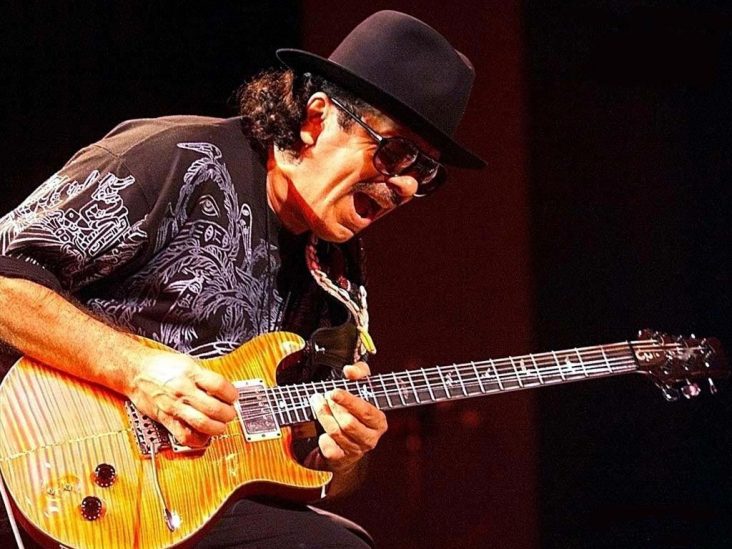
<p>Lately, the famous guitarist uses a <em>Santana II model</em> fitted with <em>PRS Santana III </em><strong>nickel covered pickups</strong><em>.</em> And for a <strong>classical guitar,</strong> he often uses the <em>Alvarez Yairi CY127CE</em> with<strong> Alvarez tension nylon strings.</strong></p>
<h2>Net Worth, Earnings and Income</h2>
<p>More than forty years in the music business, <strong>Santana sold more than 100 million records</strong>. Santana has as many albums as years in the business. The singer reached more than <strong>100 million fans</strong> at concerts as well.</p>
<p><strong>His career spans more than 50 years.</strong> Santana exemplified <strong>Latin rock</strong> and diversified it into other genres. Some of his most famous songs include <em>Smooth, Oye Como Va, Samba Pa Ti,</em> <em>Everybody’s Everything, Soul Sacrifice, Black Magic Woman</em>, and more.</p>
<p><strong>Three of his songs</strong> peaked at <strong>Number 1 on the Billboard charts</strong>. Those are <em>Smooth, Why don’t You and I,</em> and <em>The Game of Love</em>. Other <strong>high-charting songs</strong> include <em>I’m Feeling You, Into the Night, Just Feel Better, </em>and <em>Maria Maria.</em></p>
<p>Carlos Santana is <strong>far behind the richest guitar players</strong> despite having an <strong>$80 million in cash flow.</strong> <strong>Paul McCartney</strong> is the <strong>richest guitarist with a wealth of $1.2 billion</strong>. Santana cannot crack the top 10. <strong>Jimmy Page</strong>, the founder of <strong>Led Zeppelin is Number 10</strong> on the list with <strong>$170 million.</strong></p>
<h2>Personal Life</h2>
<p><strong>Born in Mexico,</strong> Carlos moved to <strong>San Francisco in the early 1960s.</strong> At this point, he already played the guitar professionally. In <strong>1965 he got American citizenship.</strong> <strong>Carlos and Deborah King got married in 1973.</strong> They have <strong>three children together.</strong> In <strong>2007, Deborah filed for divorce</strong> after <strong>34 years of marriage.</strong></p>
<p>Santana then proposed to <strong>Cindy Blackman in 2010.</strong> They got <strong>married by December 2010</strong>. They live in <strong>Las Vegas.</strong></p>
<p>Carlos Santana bought the home in Las Vegas in 2013 for $6 million.</p>

Carlos Santana – Net Worth, Career Summary, Equipment & Personal Life