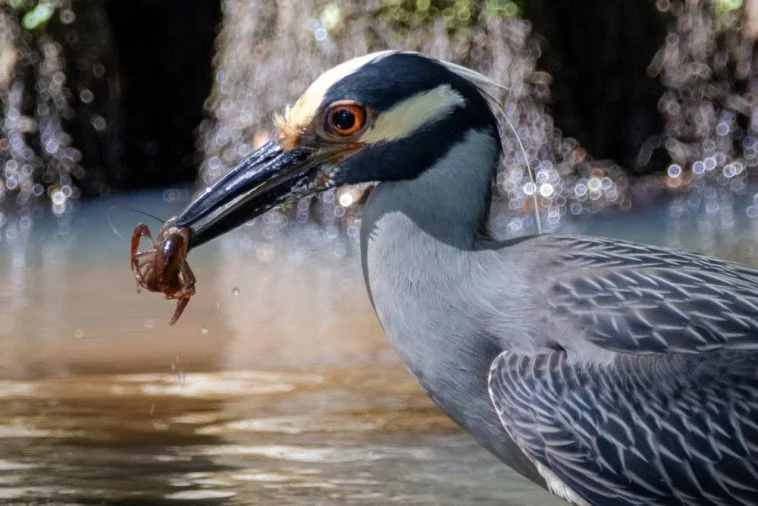
<p>Crawdads, also known as crayfish, crawfish, and crawdaddies, are small, freshwater crustaceans resembling miniature lobsters that dwell in rivers, streams, and lakes around the world. However, a curious term has been buzzing around the internet and causing quite a stir &#8211; the &#8216;crawdad bird.&#8217; Let&#8217;s take a deep dive into understanding what this term signifies and if such a bird actually exists.</p>
<p> ;</p>
<h2><strong>Crawdad: The Freshwater Crustacean</strong></h2>
<p>A crawdad is a freshwater invertebrate with a scientific name that translates to &#8220;10-footed,&#8221; reflecting its five pairs of legs. This crustacean is found in freshwater environments globally, except for India and Antarctica. Also known as Decapoda, these creatures have two large claws, called chelae, used for defense and capturing food.</p>
<p>There are nearly 600 known species of crawdads, with new varieties discovered every year. They&#8217;re omnivorous and have a diet that includes insects, algae, fish, invertebrates, carrion, and plant detritus.</p>
<p><img src="data:image/gif;base64,R0lGODlhAQABAIAAAAAAAP///yH5BAEAAAAALAAAAAABAAEAAAIBRAA7" alt="Picture of a Broad River spiny crayfish, seen close up." /></p>
<p>Crawdads come in various shapes, sizes, and colors. Some display radiant hues like the thunderbolt crayfish of New Guinea, while others, like the calico crayfish of the midwestern and eastern U.S., have simpler coloration.</p>
<h3><strong>Unique Characteristics of Crawdads</strong></h3>
<p>Crawdads boast unique features that set them apart from other crustaceans. They have a long rostrum, a pointed structure in the front of their heads that looks like a nose but serves to protect their compound eyes. Under the main part of their tail are small appendages called swimmerets that aid in movement and assist with carrying eggs. Their tail fans can curl under the body, which helps protect eggs and facilitate escape. A &#8220;tail-flip&#8221; is an instinctive reaction that propels the crawdad backward, away from a potential predator or disturbance.</p>
<p><img src="data:image/gif;base64,R0lGODlhAQABAIAAAAAAAP///yH5BAEAAAAALAAAAAABAAEAAAIBRAA7" alt="Picture of the tail of a long-pinchered crayfish." /></p>
<p>Crawdads live primarily in lakes, rivers, and streams, though some can spend a significant amount of time on land. These so-called &#8220;terrestrial&#8221; crawdads dig water-filled tunnels that they inhabit during cooler months.</p>
<h2><strong>The Puzzling &#8216;Crawdad Bird&#8217;</strong></h2>
<p>As intriguing as it sounds, there is no bird called a crawdad. The term &#8220;crawfish&#8221; is sometimes used interchangeably with &#8220;crawdad,&#8221; which could be the root of this confusion. However, while &#8220;crawfish&#8221; can refer to both crustaceans and birds, &#8220;crawdad&#8221; is used exclusively to refer to the crustacean. Hence, while a bird named &#8220;crawdad&#8221; doesn&#8217;t exist, there is a unique variety of bird called a &#8220;crawfish.&#8221;</p>
<p>In conclusion, the term &#8220;crawdad bird&#8221; is a misnomer. The term &#8220;crawfish&#8221; can refer to both crustaceans and birds, but &#8220;crawdad&#8221; solely refers to the crustacean. Even though there&#8217;s no bird named &#8220;crawdad,&#8221; there is a bird type known as &#8220;crawfish.&#8221;</p>
<h2><strong>The Role of Crawdads in Ecosystems</strong></h2>
<p>Crawdads are a keystone species, which means they play an integral role in maintaining the health of their environment. They serve as a food source for numerous animals in their ecosystems, including raccoons, foxes, snakes, turtles, fish, and waterbirds. Humans also consume them, especially in Louisiana, where people eat between 120 to 150 million pounds of them each year.</p>
<p>Despite their importance, a 2015 study found that 32% of all crayfish species are threatened with extinction, with four already extinct. The reasons for their endangerment vary by geography, with habitat loss, urban development, damming, and pollution affecting crawdads in the U.S, while climate change, overharvesting, competition from invasive species, and agricultural expansion are threats in Australia.</p>
<h2><strong>Reproduction Among Crawdads</strong></h2>
<p>Crawdads, being solitary animals, primarily interact during mating seasons, which vary across species. The mating behaviors of crawdads can be quite elaborate. Females of the signal crayfish species, for instance, chemically signal their interest by spraying urine but then go into fight mode, aggressively attacking males who respond.</p>
<p>When pairs do mate, the male grips the female and turns her so their undersides are together. Then, he uses his swimmerets to pass a spermatophore to either her external underside or into a sperm storage chamber. The female releases hundreds of eggs, which, after being fertilized, stick to her tail via an adhesive called glair. These eggs hatch into tiny adults after about a month, skipping a larval stage.</p>
<h2><strong>Conservation Efforts for Crawdads</strong></h2>
<p>Given the threats facing crawdads, conservation efforts are crucial. One-fifth of North American crawdad species are threatened with extinction, and only two percent of species occur in areas that are protected, according to the U.S. Forest Service.</p>
<p>Crawdads often serve as indicators of ecological quality and can be affected by the presence of pollutants such as antidepressants. Efforts to conserve these creatures focus on reducing habitat loss, controlling pollution, and managing invasive species.</p>
<h2><strong>The Curious Case of Self-Cloning Crawdads</strong></h2>
<p>Interestingly, the marbled crayfish species is entirely female and can reproduce without mating. These self-cloning crustaceans have become an invasive species in Madagascar, posing a unique concern for conservationists.</p>
<h2><strong>Did You Know?</strong></h2>
<p>Crawdads have a range of interesting quirks. For example, when female crawdads are carrying fertilized eggs, they are said to be &#8220;in berry.&#8221;</p>
<p>Also, crawdads exposed to low levels of an anti-depressant found in some bodies of water may become bolder. They spend more time foraging and less time hiding, potentially subjecting them to higher predation.</p>
<h2>In Pop Culture</h2>
<p>Here is a fun fact. Director Olivia Newman made a film adaptation loosely based on the best-selling novel by author Delia Owens, Where the Crawdads sing. It was adapted for the big screen by Lucy Alibar, and starred Daisy Edgar Jones, Taylor John Smith, Harris Dickinson, David Strathairn, and Jojo Regina in the main roles.</p>
<h2><strong>Conclusion</strong></h2>
<p>In conclusion, the term &#8220;crawdad bird&#8221; can be considered a misnomer. While there is a bird called a &#8220;crawfish,&#8221; the term &#8220;crawdad&#8221; refers solely to the crustacean, a keystone species in freshwater ecosystems worldwide. Despite threats to their survival, crawdads continue to play a crucial role in maintaining biodiversity and ecosystem health.</p>

Crawdad vs. Crayfish: Navigating the Confusing World of Terminology and Species